At the time of writing, I'm developing VOC STUDIO, a B2B SaaS product for collecting, managing, and analyzing voice-of-customer feedback. I've been involved from finding the idea through charging for the service, so I feel a strong attachment to it.
Perhaps work felt too familiar. I didn't think our struggles at the company belonged in a blog about trying new things and giving up. But after meeting people who found this rather reckless story interesting or motivating, I changed my mind. What follows is written more like a conversation with myself.
- Repeated Failure and Falling Self-Efficacy
- Why We Failed to Understand Our Users
- To be added.
- To be added.
ChannelTalk conversation summaries
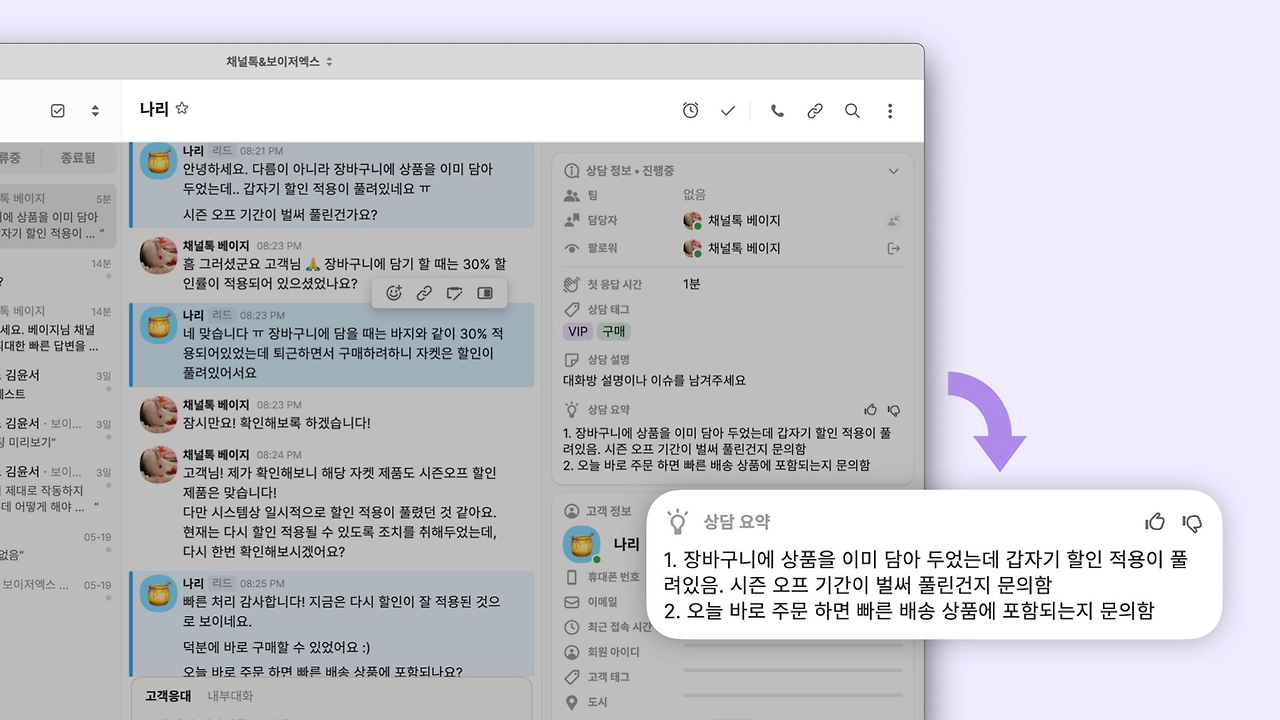
We happened upon an opportunity to build ChannelTalk's summary feature: a short account of a conversation between a customer and a customer-experience (CX) manager. For our two-developer team, it was both what we did best and what we'd already been doing. After deciding to take on the feature, we met CX managers to understand:
- Whether they actually needed summaries.
- What content and format they wanted.
- Why they weren't writing summaries, if they weren't.
- What was frustrating about the process, if they were.
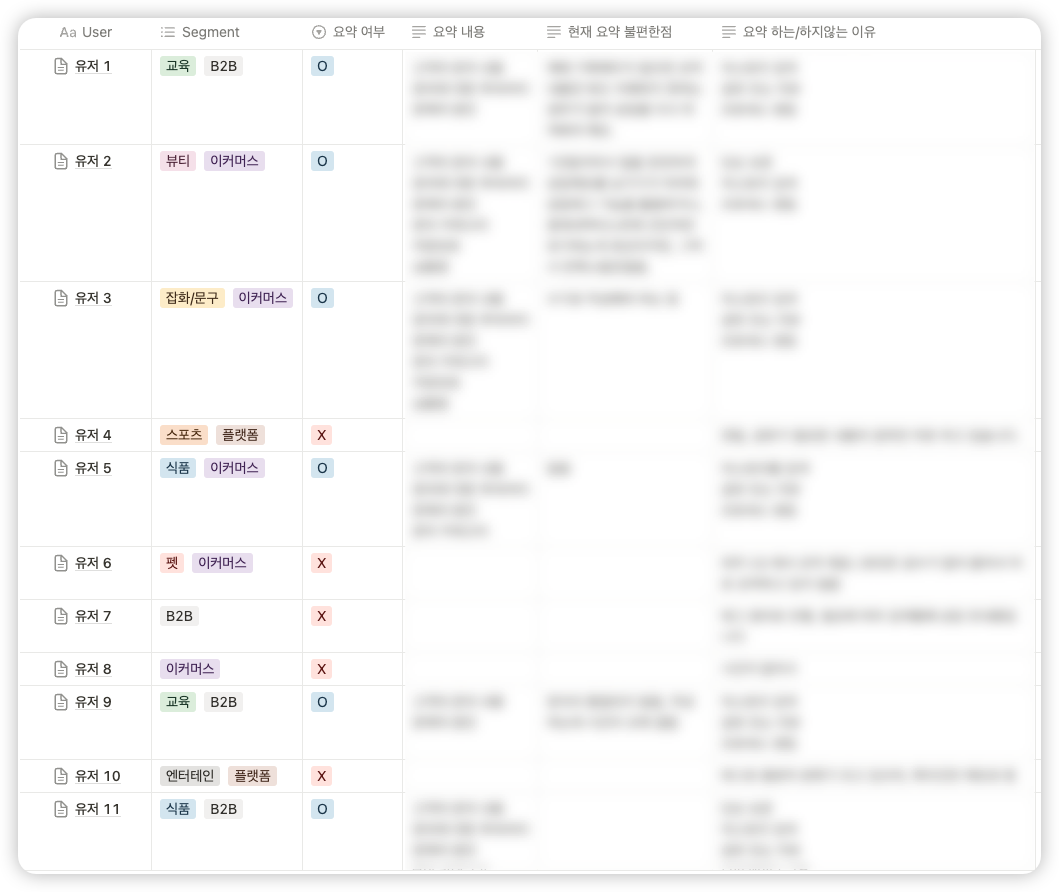
The two of us traveled around Seoul and met roughly thirty CX managers. About half the companies were manually summarizing inquiries. Among those that weren't, about half cited a lack of resources.
So if we provide good AI summaries, most of them will use them, right?
Embarrassingly, that was really how naive we were. We began development without thinking hard enough about which problem summaries solved, or whether it was painful and frequent enough for someone to pay to fix it. Still, the interviews helped us decide on the summaries' content and format.
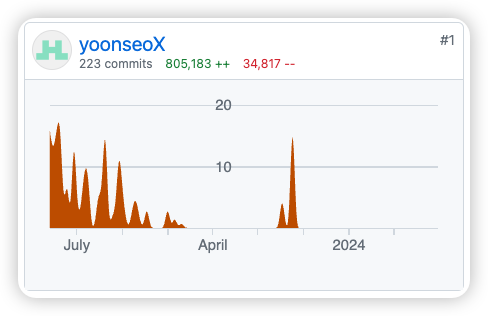
I wrote language-model training code based on the best-performing paper at the time. We had to train a fairly large model on tens of gigabytes of data with limited hardware, so there was a lot to consider. I wrote 700,000 lines of code in six months. It was probably the most development I'd done in my three years at the company. For the first time, I built a large, extensible codebase and felt I'd grown considerably as a developer. It completely restored the confidence I'd lost during the previous month.
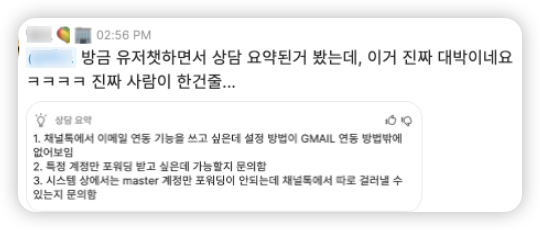
The feature reached beta on October 27, 2022. People said it was impressive and that the summaries were good, but that was where the response ended. It didn't replace the work of managers already writing summaries. Quality was one issue, but we hadn't understood deeply enough why users needed summaries or whether they were a real painkiller.
Unsurprisingly, the response was cold when we weren't clearly solving a problem. Almost no companies were using it in practice. We had spent six full months and completely failed to find product-market fit. I was about as far from lean startup practice as I could get. For several more months, we improved quality and tried different formats based on feedback. The response didn't change.
Why we needed our own service
That reception made us feel we needed both a definite user problem and a product of our own, beyond a feature inside ChannelTalk. Our ambitions for VOC STUDIO grew from the desire to solve that problem ourselves.
A summary helps someone identify a customer's issue without reading every message. When do people do that repeatedly? Interviews pointed to the process of collecting VoC. Many CX managers still read each inquiry, organize it, and manually compile feedback in spreadsheets, usually to share internally or prepare CX reports.
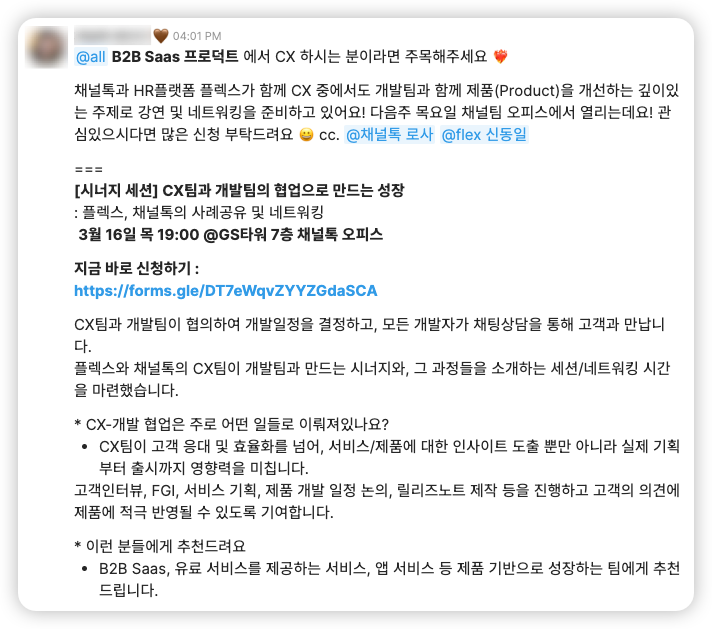
With a vague intention to improve that workflow and a desire to do something, we attended a ChannelTalk CX event on March 16, 2023. We heard firsthand accounts of the problems managers faced in their daily work:
- Frontline CX managers have many ideas for improving a product.
- They lack the resources to turn those insights into quantitative evidence.
- Most still gather and manage VoC manually in Excel, a labor-intensive process.
That conversation lit a fire under VOC STUDIO.
What did I learn?
Be obsessed with the user's problem, not the technology. Define the problem you can solve, then ask whether it is painful and frequent enough to pay for. Keep listening to why users encounter it and where it comes from. Around then, I decided that if I started a company, it would be in a domain whose users I deeply understood, or for a product where I was a user myself.
I also learned that meeting users more often doesn't automatically mean understanding them better. If you miss the central pain, the meeting may as well not have happened. Even if good, persistent questions reveal it, you still have to organize and absorb what you've heard. Talking to users frequently is no reason to congratulate yourself on understanding them.
Looking back, I wish we'd done almost everything better. We could have focused more on users, worked harder and faster, and made better decisions. We didn't. Perhaps the fact that I can see this now means I've grown. Those ten months left me with many regrets, but there is some comfort in knowing we acted quickly enough to make something at all.
For all that disappointment, one thought from Professor June Huh is still the one I like and believe most:
The winding path I took was, for me, the best, fastest, and most optimized route.
So I don't regret that time. Looking back, I can simply see how winding the road was.
Coming in part three
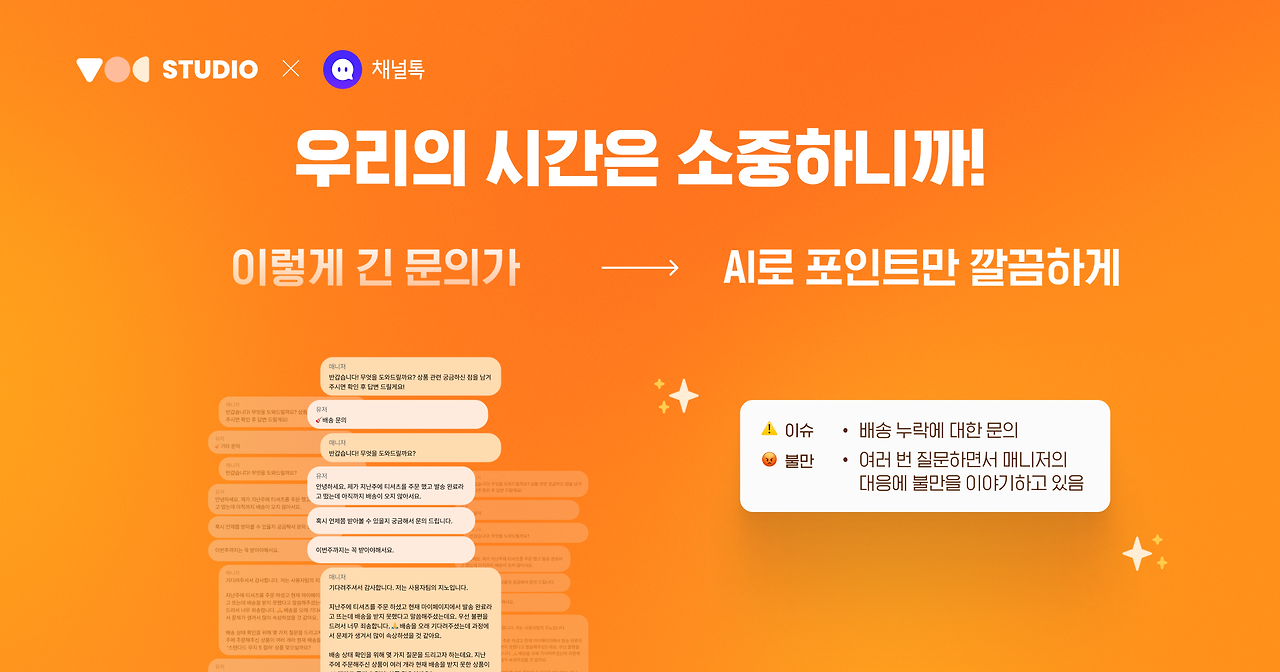
VOC STUDIO's beta launched on May 2, 2023.