This is an English translation of my Korean interpretation of a Ribbit Capital report, in four parts. I strongly recommend reading part one first.
- AI Transformation: Redesigning Business Around Tokens
- Token Sourcing: The First Opportunity and the Final Moat
- The Agent Revolution: Selling Outcomes, Not Tools
- An Abundance of Intelligence: What Becomes Scarce?
What tokens does your company provide? Can anyone else reproduce them?

Napoleon traveled with surveyors. Walmart founder Sam Walton flew a light aircraft to inspect small-town markets. Both persistently collected and analyzed information others couldn't see, drawing maps of their own.
Founders today are doing the same. They map human systems in different domains so machines can understand our world. Their tools are tokenizers.
Tokenizers: the first opportunity
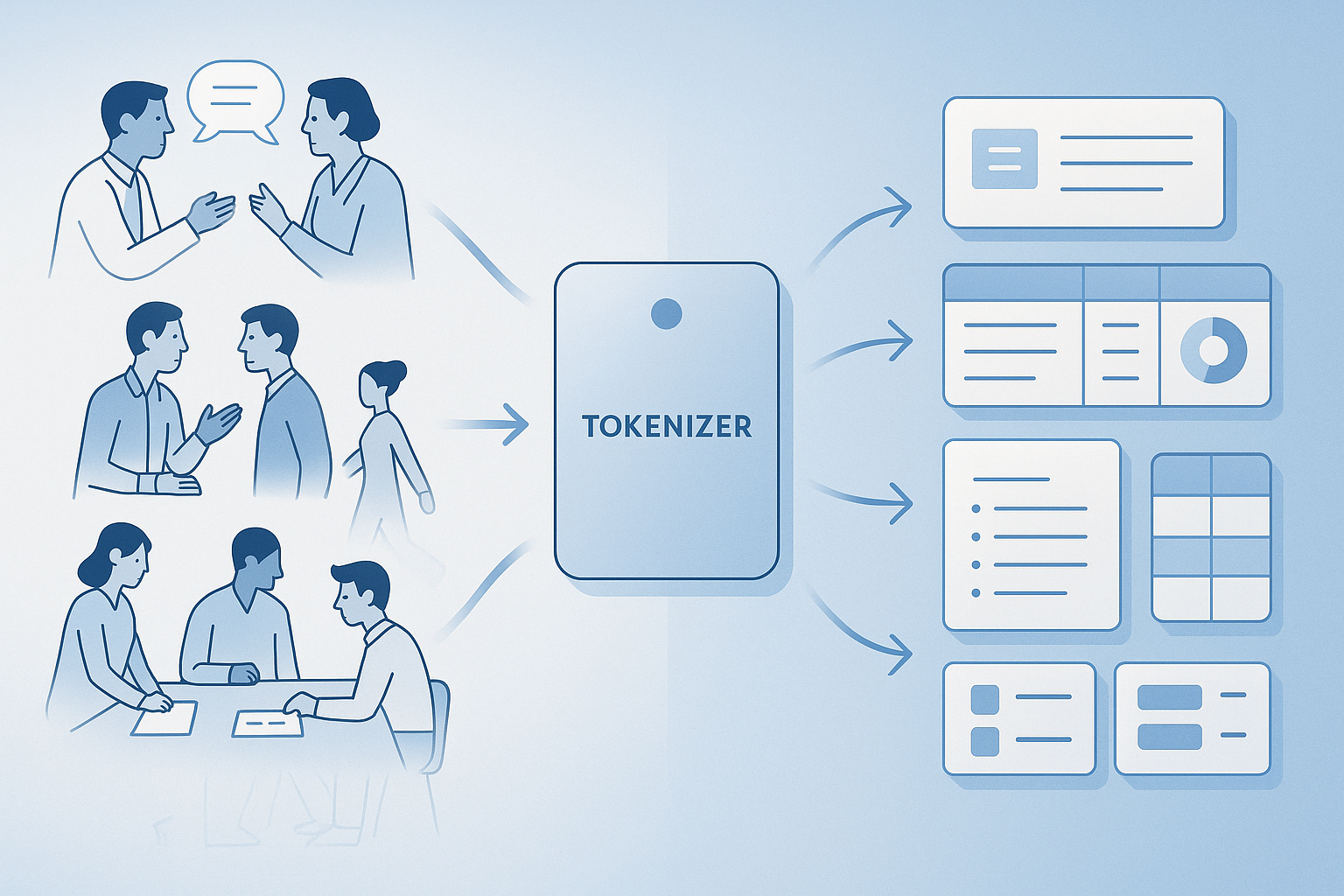
Apparently simple services could be the first killer apps of the AI era. They may look like meeting assistants or document organizers, but they solve a fundamental problem:
Turning a world machines cannot understand into tokens they can.
This takes two forms.
1. Capture fleeting information and turn it into tokens in real time.
We talk about a flood of data, yet much of the information behind decisions isn't recorded at all:
- Conversations between doctors and patients.
- A customer's movements through a physical store.
- Expressions and reactions during sales calls.
- The process of negotiating project priorities.
Important information is created every moment and mostly vanishes. Conversion tokenizers address this problem. Examples include:
- Otter: meeting audio becomes structured documents.
- Jump: wealth-management conversations become action lists.
- Gong: B2B sales meetings become structured tokens.
A single conversion creates context an entire organization can share. That small change can produce information leverage of ten or a hundred times.
2. Clean existing data that machines still cannot read.
Large companies announce that they have petabytes of data and will use it to become AI-native. The reality is often a mess of documents and logs, with employees still trapped in repetitive work.
The data exists, but it isn't machine-readable. Refinement tokenizers solve this problem:
- Reducto breaks documents into structures that can be tokenized.
- Heron Data converts financial documents and contracts into standardized metrics.
- Pulse extracts reliable structured data from enterprise documents.
They convert unstructured company data into something machines can use, removing millions of hours of routine work.
Where does the moat come from?
Many tokenizers will emerge, but generic models such as ChatGPT will absorb or displace many early services as their input types and context windows expand. Early ChatGPT supported neither images nor audio.
To last, a tokenizer must go beyond producing tokens. It must become a factory that refines them into higher-value results, absorbing expert feedback to create expert tokens. Abridge is one example.

Abridge began as a transcription tool for doctor-patient conversations. As it absorbed notes and feedback from clinicians and administrative teams, it learned patterns of language insurers would accept, expressions that improved claim approval, and structural requirements for templates.
It evolved from transcription into generating insurance-claim documents more likely to be approved. Conversation tokens combined with expert-feedback tokens produced something more valuable. That is harder for a general-purpose model to absorb.
Founders in each industry will first find an attractive, narrow area to tokenize, then build loops that keep refining the data and combining it with expert tokens to produce more valuable output.
Proprietary tokens: a moat in their own right
Tokenizers are the first opportunity, but value ultimately rests on scarcity. A few weeks after ChatGPT launched, Ribbit Capital asked internally:
“If we invested in data rather than companies, what data would we buy?”
Gold, oil, rare earths, social graphs, and search traffic have each been strategic scarce resources. What tokens could play that role in the AI era?
Tokens machines can never create for themselves, and that only a few companies can control.
There are four categories.
1. Identity tokens
Biometrics, identity information, digital IDs, and verified accounts represent a person. Legal and technical barriers, together with the trust required in an issuer, mean few organizations can issue them.
2. Context tokens
Behavior, patterns, and preferences: search history, transactions, location over time, investment habits. They reveal where a person spends time and money and help machines understand that individual.
3. Access tokens
Permission to reach sensitive resources, such as payment credentials, bank accounts, and medical records. Like identity tokens, these depend on a small number of issuers and economies of scale.
4. Memory tokens
Context an agent accumulates about a person over time. ChatGPT Memory is an example. Because this information develops through a long relationship, it is difficult to reproduce. A future “Login with ChatGPT” might share such memory with other agents or token factories.
Memory is more than a feature. It could be an early attempt to standardize how AI understands a person. As memories accumulate, people become more deeply attached to the platform.
How much personal information do you share with ChatGPT? Google earns $264 billion from search intent and Meta $164 billion from interests. What might OpenAI earn through much more precise personalization based on memory tokens?
The first opportunity is tokenization; the lasting advantage is proprietary data
AI transformation begins with capturing conversations, behavior, documents, and physical activity that previously went unrecorded, and refining messy material into machine-readable structures.
The deeper contest comes afterward: absorbing feedback into expert tokens, then controlling identity, context, access, and memory tokens machines cannot generate on their own.
The competition may look like a race between models. Underneath, it is a contest over who can source and control which tokens. Companies that capture fleeting data will seize the first opportunity. Those accumulating proprietary tokens will be the eventual winners.
What data is your company accumulating, and which of it is proprietary?
That question could be the starting point for the next decade.