KAIST KIXLAB · Ongoing research
Human–AI Collaborative Problem Solving
Research on how people and AI develop a shared understanding of a task.
At KAIST KIXLAB, I study how users and LLMs understand and revise goals, constraints, and preferences during open-ended tasks. I am analyzing conversations and helping prepare a formative study. Earlier work explored ways to make an answer’s assumptions easier to review.
- Period
- Sep 2026 — Present · Updated Nov 5, 2026
- My role
- Research Intern · Advisor: Prof. Juho Kim
- Status
- Ongoing analysis and study preparation
01 / Current work
Study the collaboration across a task
I am examining how people and AI frame a problem, propose solutions, explain choices, and evaluate what they produce. I want to understand where their interpretations diverge and how people notice and address those differences.
We are preparing tasks that require substantive judgment with AI assistance. Current work includes a data-driven dashboard task where participants choose the questions, measures, and structure. The study is still in preparation.
Extraction methods, prototypes, and exploratory pilots
Conversation analysis
Tasks and procedures for a formative study
02 / Earlier method work
Preserve what the user said
I separated two tasks that can otherwise become mixed. The first is to preserve information the user explicitly gave. I adapted atomic content unit extraction to conversation: breaking messages into short statements while keeping negation, conditions, and preference strength.
The second is to reconstruct conditions an AI answer depends on. I investigated argumentation-based methods for this. A condition that sounds plausible is not necessarily one supported by the answer.
“A hotel is not required.”
03 / The prototype
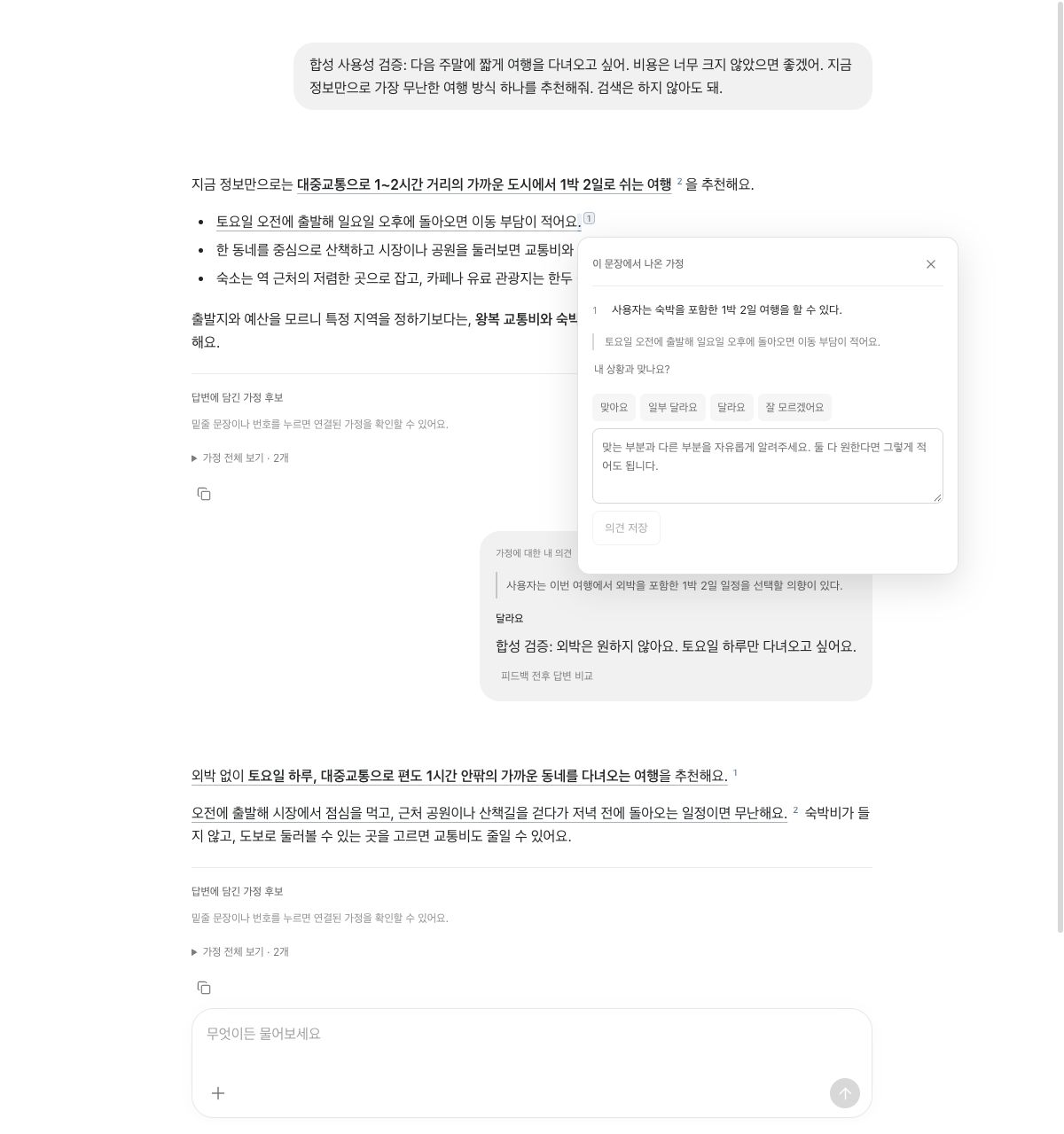
Link a candidate assumption to the answer it supports
I built prototypes that link candidate premises to passages in an answer, let users critique them, and carry corrections into a revised answer. I defined the extraction boundaries and reviewed whether the outputs preserved meaning. The implementation and experiment tools were developed with AI assistance.
Exploratory pilots helped us examine the candidates and the review interaction. A candidate can be faithfully extracted without being useful to a participant, and a useful-looking correction does not by itself establish a better decision.
Explore the town in the afternoon.
Stay at a hotel nearby.
An overnight stay is possible.
“I need to return home each day.”
Contribution & outcome
Work completed and questions still open
- Earlier work
- Extraction-method investigation, review prototypes, and exploratory pilots.
- Current work
- Conversation analysis and preparation of tasks and procedures for a formative study.
- Open question
- When reviewing assumptions helps users recognize and address important differences in understanding.
This is ongoing research. The earlier pilots are exploratory, and the benefit of an intervention has not been established. The examples shown here are constructed, not participant records.